
Annamarie Rodriguez, MS, RDN, LD, DipACLM, FAND
Let’s make 2026 the year of the New You! Or maybe the New Gut! Making simple changes to the diet builds a stronger and healthier gut, which means a stronger and healthier you! It seems each day there is emerging research on the microbiome and its impact on health and longevity, and this has never been truer regarding kidney health. In the Nov./Dec. 2025 issue of aakpRENALIFE magazine, we spoke about the benefits of the PLADO diet in reducing complications of chronic kidney disease (CKD) and reducing the progression of it. This approach encourages a high fiber intake >25 grams (g) per day1, and while >25g seems like a high fiber intake, it is a normal intake. Fiber recommendations for adults, from the Dietary Guidelines for Americans, 2020-2025, range from 22 to 34 gram (g) per day based on age and sex.2 The easiest way to boost fiber intake is the inclusion of whole grains, fruits and vegetables (F+V).
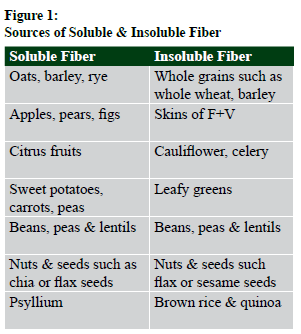
The many health benefits of fiber range from protective properties against cancer, heart disease, and diabetes, to helping to manage blood glucose for those who have diabetes, and its role in gut health. Fiber types are soluble and insoluble, and both have important health benefits. Soluble fiber forms a gel-like substance and acts like a sponge to help control blood sugar and cholesterol. Insoluble fiber does not dissolve, and it passes through the stomach acting like a scrub brush keeping bowels regular and healthy. Check out Figure 1 to review food sources that provide soluble or insoluble fiber; you’ll note several food sources provide both: these are fiber powerhouses! Although fiber is known to play a vital role in overall health, just 7% of adults in the United States meet fiber recommendations, raising the risk of chronic diseases.3
How does increased fiber benefit CKD?
The benefits of F+V intake correlating to an increased fiber intake results with the reduction of uremia in the blood,4 reduced net endogenous acid production (NEAP),5 improved gut microbiome, reduced mortality, reduced cardiovascular disease in CKD and in one study, every extra 1 gram of dietary fiber was associated with an 11% reduction in cardiovascular events.6 This outcome is multifactorial as these foods have a lower acid load, promote colonic microbial activity, contain antioxidants, and are anti-inflammatory.6,7
When it comes down to focusing on fiber, the gut and CKD, plant-based foods generate fewer uremic toxins, reduce proteinuria, and tempers GFR decline through a variety of mechanisms other than simply a reduction in protein intake. This includes alterations in the gut microbiome. Plant-based diets favorably shift gut bacteria from a proteolytic profile to a saccharolytic profile, resulting in:8-10
• Promotion of short-chain fatty acids,
• Stronger intestinal barrier integrity,
• Inflammation reduction, and
• Improved immunity
This shift in the gut bacteria reduces production of key uremic toxins that are known to promote CKD, such as:
• P-cresyl sulfate
• Indoxyl sulfate
• Indole-3-acetic acid
• Trimethylamine-N-oxide (TMAO)
These uremic toxins are associated with animal protein and favor growth of proteolytic bacteria in the gut microbiome.8 It is important to note that TMAO is a biomarker of both cardiovascular disease and CKD, as well as a renal toxin.11 Both the reduction of protein, the replacement of animal protein with plant protein, and increased fiber intake lends a multifactorial approach to the preservation of kidney function. For example:
• In a study with people who have normal kidney function, there was ~60% decrease in the uremic toxins, p-cresyl sulfate and indoxyl sulfate in persons following a vegetarian versus an om-nivorous nutrition lifestyle.12
• Conversely, in a cross-sectional study on per-sons undergoing renal replacement therapy, those following a vegetarian diet had a 47% and 67% lower indoxyl sulfate and p-cresyl sulfate, respectively.13
Fiber benefits go beyond eliminating toxins, other chemicals and aiding kidney health.
Fiber helps to keep us feeling fuller on fewer calories, meaning it can help us slash our calorie intake and assist with weight loss. Benefits of a fiber-rich diet are weight management, cholesterol reduction, improved blood glucose management, toxin reduction, improved satiety, regularity, and fiber aids in fighting chronic diseases or the progression of chronic diseases; fiber is KING!
Because we know fiber plays a significant role in building a healthy gut microbiome, there are several things you can do to nurture your healthy gut!
Eat a broad/diverse plant rich diet that includes a variety of grains, F+V: eat a rainbow of plants! Use the 50-25-25 plate rule to focus on veggies & grains. Another fun rule is the 1,2,3 Rule for F+V. 1 serving at breakfast, 2 servings at lunch, and 3 servings at dinner! Check out Figure 2 as an example of the 1,2,3 Rule.
Include fermented foods and prebiotics.
• Examples of fermented foods (probiotics) include kimchi, yogurt, kefir, sauerkraut, miso, tempeh, kombucha, sourdough bread.
• Examples of prebiotic foods include garlic, on-ion, bananas, oats, apples, seaweed, avocado, flax seeds, wheat bran, lentils.
Limit Processed food & sugar.

Lifestyle habits can help build a healthy gut microbiome, too:
• Manage stress: try breathing exercises, medita-tion, yoga, or tai chi.
• Exercise: moderate physical activity for at least 30 minutes each day influences the gut.
• Hydration: stay adequately hydrated with water. Caution: Speak with your health care provider if you have a fluid restriction.
• Sleep: prioritize restful, quality sleep of about 6 to 8 hours per night.
A healthy, plant-rich diet and a positive focus on lifestyle habits will reward you with a healthy gut microbiome and in turn, the advantages of health and energy!

Annamarie Rodriguez has almost 30 years of experience in a vast array of settings surrounding chronic diseases, and specifically with kidney disease. She owns Nutrition Directions, LLC providing dietitian/nutrition consulting services and is dedicated to serving the community to advocate for health equity to advance preventative measures and decrease the incidence and progression of chronic disease. She has a Master’s in Health and Wellness Management, is a Certified Lifestyle Medicine Professional, and is a Licensed Food for Life Instructor. She believes that each person is on their own personal “food journey” and the direction of nutrition care is personalized, empowering patients to sustainable life changes. She looks forward to partnering with her patients on their food journey to find the direction of nutrition that is just right for them.
References:
1. Kalantar-Zadeh K, Joshi S, Schlueter R, et al. Plant-dominant low-protein diet for conservative management of chronic kidney disease. Nutrients. 2020;12(7):1931.
2. Fiber: The Carb that helps you manage diabetes. Centers for Disease Control and Prevention. May 15, 2024. https://www.cdc.gov/diabetes/healthy-eating/fiber-helps-diabetes. html.
3. ASN Staff. Most Americans are not getting enough fiber
in our diets. American Society for Nutrition. June 9, 2021. https://nutrition.org/most-americans-are-not-getting-enough-fiber-in-our-diets/.
4. Rampton DS, Cohen SL, Crammond VD, et al. Treatment of chronic renal failure with dietary fiber. Clinical Nephrology. 1984;21(3):159-163.
5. Kraut, J. A., & Madias, N. E. (2016). Metabolic Acidosis of CKD: An Update. American Journal of Kidney Diseases, 67(2), 307-317.
6. Wang AY-M, Sea MM-M, Ng K, et al. Dietary fiber intake, myocardial injury, and major adverse cardiovascular events among end-stage kidney disease patients: A prospective cohort study. Kidney International Reports. 2019;4(6):814-823.
7. Evenepoel P, Meijers BK. Dietary fiber and protein: Nutritional therapy in chronic kidney disease and beyond. Kidney International. 2012;81(3):227-229.
8. Nallu, A. Gut microbiome in chronic kidney disease: challenges and opportunities. Translational Research Volume 179, January 2017, Pages 24-37
9. Mafra D, Borges N, Alvarenga L, et al. Dietary components that may influence the disturbed gut microbiota in chronic kidney disease. Nutrients. 2019;11(3):496.
10. Camerotto C, Cupisti A, D’Alessandro C, Muzio F, Gallieni M. Dietary fiber and gut microbiota in renal diets. Nutrients. 2019.
11. Fogelman AM. Tmao is both a biomarker and a renal toxin. Circulation Research. 2015;116(3):396-397.
12. Patel KP, Luo FJ-G, Plummer NS, Hostetter TH, Meyer TW. The production of p-cresol sulfate and indoxyl sulfate
in vegetarians versus omnivores. Clinical Journal of the American Society of Nephrology. 2012;7(6):982-988.
13. Kandouz S, Mohamed AS, Zheng Y, Sandeman S, Davenport A. Reduced protein bound uraemic toxins in vegetarian kidney failure patients treated by haemodiafiltration. Hemodialysis International. 2016;20(4):610-617.